What it actually feels like
You sit down to work at 10am. You think you have been working for maybe forty minutes. You look up and it is 2:47pm. Or the reverse: you feel certain you have been at the desk for hours, grinding through something hard, and it has been eleven minutes. Time exists in two states: now and not-now. The interval between a deadline and the present moment is not a quantity you can feel. It is just an abstraction that becomes suddenly, catastrophically real the moment it expires.
ADHD adults on r/ADHD describe this consistently. "Unless I pay special attention, my perception of time is as if I want to deliberately forget it," one user study participant explains (arXiv 2603.17258). Another: "I get 8 hours of work done in 1 or 2 hours, or I get nothing done for days." The binary is real. Time does not feel like a river passing. It feels like an on-off switch.
The coping workarounds are creative and consistent: setting clocks 10 to 15 minutes ahead, wearing a watch instead of using a phone because watches do not have notifications competing for attention, setting "pre-alarms" to go off 10 minutes before a meeting instead of at the meeting, writing down the start time for every task and doing the arithmetic manually. These work to varying degrees. They all address the same underlying problem: the brain is not generating reliable internal time signals, so the person has to import them from the environment.
What Barkley's model says about why
Russell Barkley's executive function model, which underpins most current clinical thinking about ADHD, frames time blindness not as a symptom of inattention but as a deficit in prospective memory and temporal foresight. The ADHD brain has difficulty with what Barkley calls "working with time": holding a future event in mind and working backward from it to determine what you need to do now. This is not forgetfulness in the ordinary sense. It is a failure of the internal clock that tracks elapsed time and projects it forward.
The meta-analysis by Zheng et al. (Journal of Attention Disorders, 2022) across 27 studies and 2,869 participants quantified this precisely. ADHD adults perceive time less accurately (effect size g greater than 0.40) and less precisely (g=0.66). Critically, they tend to overestimate how much time has elapsed, which means the subjective feeling that "it's been forever since I started this" often occurs at the 5-minute mark, creating a false signal that the person has already put in substantial effort and deserves a break.
This is not a motivation problem. It is a perception problem. Treating it as motivation produces shame and tips aimed at "caring more" about deadlines. Treating it as perception produces the question: what external signals can substitute for the internal ones that are not generating reliably?
What has actual evidence: visible timers
Wennberg published a randomized controlled trial in the European Child and Adolescent Psychiatry journal in 2018 testing a visible analog timer intervention in children with ADHD. The format was a timer that showed elapsed time as a shrinking colored area, similar to the Time Timer commercial product. The effect size on time processing and daily time management outcomes was d=1.0.
A d=1.0 effect is large by Cohen's conventions. For reference, the widely-cited effect of stimulant medication on ADHD symptoms is in the d=0.8 to 0.9 range in meta-analyses. A visible timer intervention approaching that magnitude is not a small thing. And the mechanism explains why it works at the level of the deficit itself: the analog timer makes elapsed time perceptible as a visual quantity without requiring any cognitive computation. You see a shrinking arc. You do not need to subtract 10:00 from 10:43. The time information is in peripheral vision, available continuously, requiring no active attention to interpret.
A digital clock showing the current time does not do this. You have to remember what time it was when you started, compute the delta, and hold the result in working memory to know how much time has passed. Every step in that chain is impaired in ADHD to some degree. Working memory deficits are documented at d=0.69 to 0.74 in meta-analyses (Weigard et al., Frontiers in Psychiatry, 2024). The analog timer bypasses the chain entirely.
The "Time isn't abstract anymore. I can SEE it," quote that appears repeatedly in ADHD app reviews about visual planners is not just a nice line. It is users accurately describing the mechanism.
What has actual evidence: implementation intentions
Time blindness interacts with task transitions in a specific way. When a session ends, or when you need to switch from one task to another, the ADHD brain faces a double challenge: the impaired internal clock makes it hard to know whether the session is "really" over, and the executive function deficit makes it hard to initiate the next action without something concrete to grab onto.
Implementation intentions address the transition problem directly. The format is specific: "If situation X occurs, then I will perform action Y." Applied to task transitions: "If I finish writing the first paragraph, then I will immediately open the reference document." Wieber, Thuermer, and Gollwitzer (2015) ran a meta-analysis of 28 studies across 1,636 participants testing this format and found a mean effect size of d=0.99.
The earlier work by Gawrilow and Gollwitzer (2008) is particularly striking. They tested implementation intentions specifically in children with ADHD and found something remarkable: the if-then plan format normalized the P300 ERP brain response, which reflects cognitive resource allocation. In other words, the if-then plan changed the neural processing signature. Children with ADHD who used implementation intentions showed brain activity patterns closer to neurotypical controls during the task-switching phase. Combined with stimulant medication, it produced the highest performance of any combination tested in that study.
d=0.99 is a large effect. It is also a behavioral technique with no side effects, no cost, and no app required. The question is whether an app can reliably generate and present these intentions at the right moment, which is where KickMint's on-device AI does specific work.
What does not have evidence for time blindness specifically
A lot of what is sold as time management support for ADHD does not address the time perception deficit at all. Being clear about this is useful.
Gamified streaks. Streak mechanics address motivation and habit formation. They do not improve time perception. For ADHD adults, broken streaks often trigger what researchers describe as rejection-sensitive dysphoria responses: disproportionate emotional reactions driven by amygdala hyperreactivity and impaired prefrontal regulation (Banaschewski et al., ECAP 2025, 80-study meta-analysis, n=6,191). The research on streaks in ADHD apps is damning: "every broken streak is a fresh shame event," as one behavioral research summary puts it. App abandonment follows. Streaks are a motivation mechanic for neurotypical users grafted onto a user base for whom they frequently cause harm.
Dopamine-hit notifications. Push notifications that say "Time to work!" are attention interrupts. They do not train time perception or provide a substitute for the missing internal time signal. On r/ADHD, the community summary on notifications is bleak: "There is no notification yet invented that I can't ignore." Notifications have their place as external cues for specific timed events, but they are not a time blindness intervention.
AI motivational coaching. "You've got this!" messages from an AI assistant do not address the executive function deficit. They address the emotional experience of having the deficit. That is a different problem, and mixing them up leads to products that feel warm but do not actually help. We are not saying emotional support features are worthless: there is research on self-compassion and shame reduction that matters for ADHD. But calling motivational coaching a "time management feature" is mislabeling.
Calendar time blocking without visibility. Blocking out "2pm to 4pm: deep work" gives the person a plan. It does not give them a mechanism for perceiving whether those two hours are passing or have passed. The plan and the perception are different problems. Time blocking addresses scheduling. Visible timers address perception during the scheduled time.
How KickMint implements the research
The visible focus timer ring
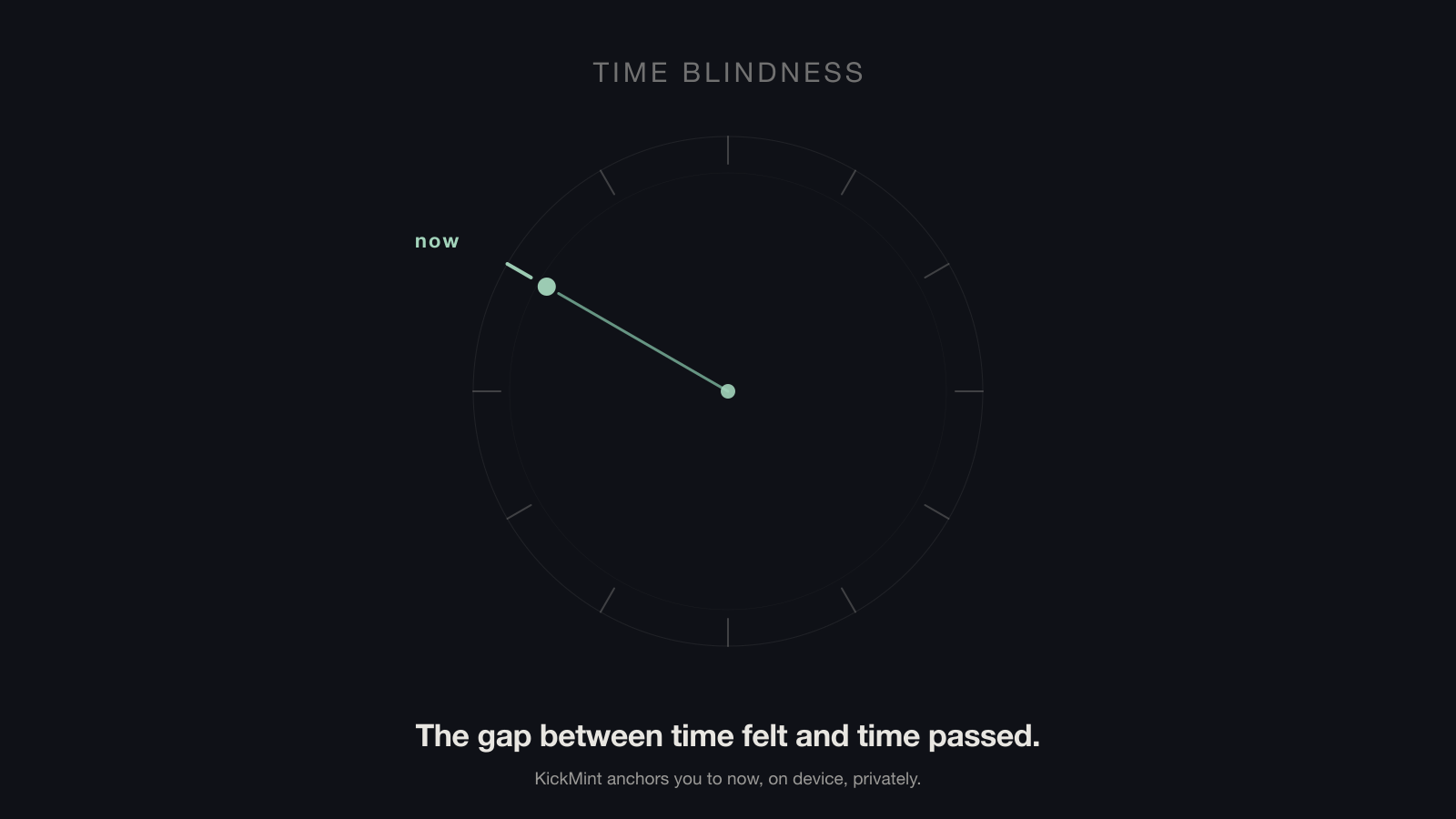
When you start a focus session, a ring timer fills clockwise around the session card showing time elapsed, not time remaining. You see what you have already done, not what you have not done yet. That framing is deliberate: showing time remaining produces loss framing ("only 7 minutes left"), which triggers urgency and for many ADHD adults triggers a stress response. Showing elapsed time produces progress framing ("I've been at this for 18 minutes"), which is accurate information without the adrenaline spike.
Session lengths are 5, 25, or 45 minutes. The 5-minute option is specifically for the tasks that feel impossible to start. A 5-minute commitment is concrete enough to bypass the freeze response. If you can just do 5 minutes, that is a real session. The ring shows you got through it.
The Time-Now Anchor
The Time-Now Anchor sits at the top of the Focus screen as a quiet strip. It shows where "now" sits relative to lunch and end-of-work, using relative positioning rather than clock time. "Before lunch." "Between lunch and end-of-work." "After work." No clock, no countdown, no urgency language. The anchor connects time to events rather than numbers, which is more meaningful for time-blind perception because events have weight that numbers do not. You know what "before lunch" feels like. "10:43 AM" does not generate the same visceral orientation.
The reference points are customizable. If your end-of-work is 7pm instead of 6pm, you set that in settings. The anchor adjusts.
Implementation intentions in task breakdown
When KickMint's on-device AI breaks a task into micro-steps, each step comes wrapped in the if-then format: "If you finish [step one], then immediately [step two]." This follows the Wieber meta-analysis format exactly: specifying the situation cue (finishing the previous step) and the committed action (starting the next one). The transition is pre-decided before it happens. When you arrive at the end of step one, the next action is already loaded.
This matters at the moment sessions end. If you cannot complete a session, the if-then gives you a clean handoff state: "I got through the draft introduction; the if-then is 'if I sit back down, I open the sources folder first.'" The next session starts from a defined cue rather than from a vague sense of "where was I?"
The Time Estimation Trainer
When you start a task, KickMint suggests a session length based on your history with similar tasks. At the end of the session, the app records whether you finished and how long it actually took. The delta between guess and actual accumulates over time and is shown in the Insights screen. The suggestion improves gradually as it learns your actual pace rather than your optimistic guess.
This is the Wennberg finding applied longitudinally: rather than only providing a visible timer during sessions, the app also builds a calibration model specific to you. The time estimation deficit is real and persistent, but it can narrow with feedback. Gradually, "this task feels like a 25-minute task" becomes more accurate for recurring task types because the app has been tracking the gap between feeling and reality.
Pick One and the session length problem
Time blindness interacts with task selection in a specific way. If you cannot estimate how long a task will take, choosing which one to start based on available time is genuinely difficult. You have 40 minutes before a meeting. Is that enough to make a real dent in the report? Or should you do the three smaller tasks instead? For ADHD adults who cannot reliably feel how long tasks take, this decision is often paralyzing.
Pick One removes it. The app reads your adaptive state (energy, time of day, optional medication window, optional cycle phase) and picks the task. It also picks the session length. You confirm one choice rather than generating two. The cognitive load goes to near zero. The Frontiers in Psychology 2021 RCT on task decomposition with metacognitive prompting found that the combination of decomposition and metacognitive structure (asking "what is this task really asking?") outperformed decomposition alone. Pick One is partly a metacognitive scaffold: it makes one judgment on your behalf so you can use your available cognitive bandwidth for the actual task.
A note on what is realistic
Time blindness is a persistent feature of ADHD, not something any app eliminates. The Wennberg study showed large effects for visible timers on time processing. It did not show that ADHD participants became neurotypical time perceivers. The Time Estimation Trainer will improve your estimates for recurring tasks. It will not eliminate the deficit for novel tasks. Implementation intentions help at transitions. They do not remove the ADHD brain's tendency to lose track of time during the session itself.
KickMint is iOS only. iPhone 14 and newer for full on-device AI. iPhone 11, 12, and 13 use rule-based fallback. If your phone is on the older end, the AI breakdown features are limited, though all the time-blindness features (visible timer ring, Time-Now Anchor, Time Estimation Trainer) work on all supported hardware.
The app helps with specific, documented failure modes. It does not fix time blindness. Nothing does. But tools calibrated to the actual research perform better than tools built on marketing copy about "unlocking your potential."
Related reading
Frequently asked questions
What is time blindness in ADHD?
Time blindness is a deficit in prospective time monitoring: the ability to track how much time has passed without external reference. Russell Barkley's executive function model frames it as a failure of prospective memory and temporal foresight, not inattention or laziness. Research on ADHD documents consistent impairments in time reproduction, time estimation, and prospective timing. A meta-analysis by Zheng et al. (2022) across 27 studies and 2,869 participants found ADHD adults perceive time less accurately (g greater than 0.40) and less precisely (g=0.66).
What does the Wennberg 2018 study show about visible timers?
Wennberg (ECAP 2018) conducted a randomized controlled trial testing a visible analog timer on time processing in children with ADHD. The study found a large effect size of d=1.0 on time management outcomes. A visible analog timer makes elapsed time perceptible as a shrinking visual area rather than requiring the person to track digits. This offloads the time-monitoring work to the visual environment rather than internal cognitive resources.
What are implementation intentions and how do they help ADHD?
Implementation intentions are if-then plans specifying when, where, and how a person will act toward a goal: "If I finish the email, then I will immediately open the invoice spreadsheet." Wieber, Thuermer, and Gollwitzer (2015) analyzed 28 studies of implementation intentions across 1,636 participants and found a mean effect size of d=0.99. The format reduces the cognitive load of transitioning between tasks by pre-loading the next action as an automatic response to a situation cue, which is where ADHD adults most often freeze.
How does the Time-Now Anchor work in KickMint?
The Time-Now Anchor is a quiet strip at the top of the KickMint Focus screen. It shows where "now" sits relative to two anchor points: lunch and end-of-work. It does not show a countdown or a clock. The goal is to give the ADHD brain a concrete sense of where it is in the day without creating urgency or shame. It connects time to events rather than numbers, which is more meaningful for time-blind perception. It is available in the free tier.
What is the Time Estimation Trainer in KickMint?
The Time Estimation Trainer shows the difference between your estimated session length and actual completion time over time. When you start a task, KickMint suggests a session length based on your history with similar tasks. After the session, the app records the actual time. The delta between guess and actual is displayed over time. This creates a feedback loop that gradually improves your time estimation accuracy, addressing the time estimation deficit directly rather than working around it.
Does KickMint use alarms or urgency cues for time blindness?
No. The time blindness features in KickMint, specifically the visible focus timer ring and the Time-Now Anchor, use visual information rather than alarms or urgency cues. Research on ADHD and emotional regulation (including amygdala hyperreactivity documented across 80 studies by Banaschewski et al., ECAP 2025) suggests that urgency cues can trigger stress responses that worsen executive function. KickMint's timer ring shows time elapsed (the filled arc) rather than time remaining (the empty arc), framing progress rather than loss.
Do gamified streaks and dopamine notifications actually help with time blindness?
No, not specifically for time blindness. Streak mechanics address motivation and habit formation, not the neurological deficit in time perception. Notifications are attention interrupts, not time perception aids. For ADHD adults who struggle with amygdala hyperreactivity, broken streaks can trigger shame spirals that cause app abandonment. The interventions with published RCT evidence for time blindness specifically are visible timers (Wennberg 2018, d=1.0) and implementation intentions for task transitions (Wieber 2015, d=0.99).