The real cost of ADHD app subscriptions
You downloaded an app six months ago. You used it for three weeks, then got busy, then forgot it existed. The subscription is still running. You do not know how many subscriptions like this are active right now. This is not a hypothetical. It is a documented pattern specific to ADHD adults.
The condition that makes ADHD apps appealing, impaired prospective memory and difficulty tracking ongoing commitments, is the same condition that makes subscription models particularly costly for this population. Adults with ADHD face roughly twice the rate of credit problems and bankruptcy compared to neurotypical adults, driven in part by impulsive purchases and the difficulty of remembering which monthly charges are quietly accumulating. The irony of ADHD-specific apps monetizing through the mechanism that most exploits ADHD impairments has not gone unnoticed in the community. One review of a subscription ADHD app put it plainly: "There's something particularly sinister about subscription-based apps aimed at people with ADHD. They'll get excited about it, but then forget to cancel anyway, won't they?"
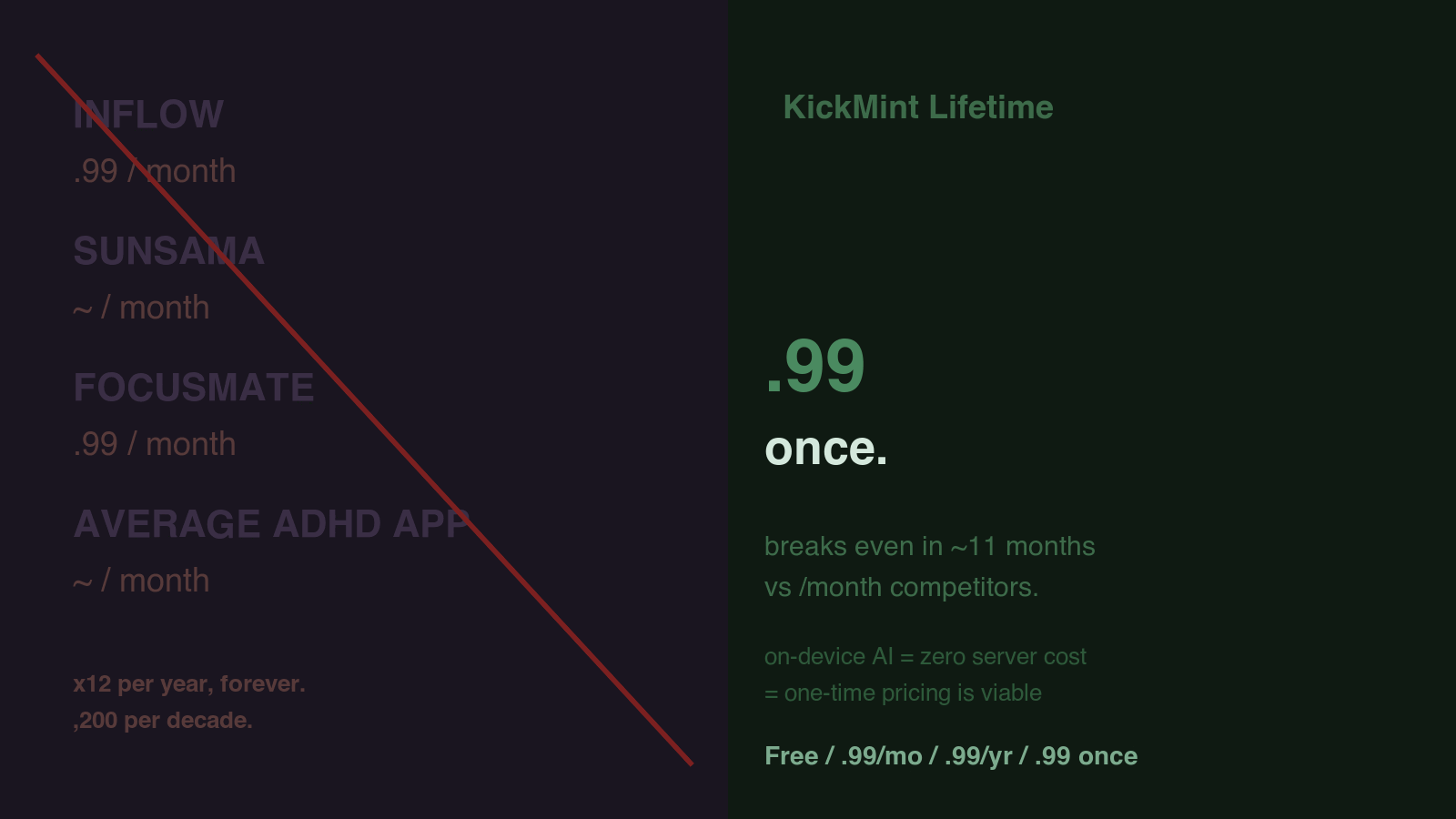
Pricing across the ADHD productivity category runs roughly $5 to $20 per month, checked 2026-08-30. Several of the best-known apps do not publish a number at all: Inflow shows its price only after an intake quiz, and Tiimo's own FAQ says the amount appears at checkout. Goblin Tools keeps its core tools free and sponsor-funded, and now also sells a Pro tier whose price is visible only after sign-in. Saner.ai publishes $16/month, or $8/month billed yearly, alongside a free tier (checked 2026-08-30). We have stopped quoting competitor figures we cannot verify from the vendor directly. Taking $10 per month as a rough category midpoint:
- One year: $120
- Two years: $240
- Five years: $600
- Ten years: $1,200
Most ADHD adults are not using the same app for ten years. The novelty cliff documented in ADHD research suggests that the average app engagement window is between two and eight weeks before the dopamine hit from the new system fades and the app starts collecting dust. But the subscription often continues. The charge does not fade when the engagement does. And the next app starts its own subscription.
The KickMint pricing structure, clearly stated
KickMint has three paid options, all through the Apple App Store, plus a free tier:
- Free: Pick One, voice capture, rule-based task breakdown, visible focus timer ring, Panic Button with paced breathing, Stealth Mode, Time-Now Anchor for time blindness, gentle streak protection, Waiting Mode for calendar gaps, medication-aware and cycle-aware ordering in Pick One, and Time Estimation Trainer. No payment required.
- Pro monthly: $8.99 per month. Adds on-device AI task breakdown (Qwen 2.5 1.5B) sized to your cycle phase, the full focus soundscape library, sound calibration, detailed weekly insights, and AI re-break when stuck. 30 free Pro days covering every Pro feature, starting on first use.
- Pro yearly: $59.99 per year ($5.00 per month equivalent). Same Pro features. 30 free Pro days covering every Pro feature, starting on first use.
- Lifetime: $209.99 once. Same Pro features, no further payment.
The breakeven math for Lifetime:
- Versus Pro monthly: $209.99 / $8.99 = 23.4 months. From the third year onward, Lifetime costs nothing additional.
- Versus Pro yearly: $209.99 / $59.99 = 3.5 years.
- Versus the ADHD app market average of $10 per month: breakeven at approximately 21 months, and roughly $990 saved across a decade.
The 30-day free trial unlocks every Pro feature. If the app does not work for you, the trial ends without charge and you stay on the free tier. The trial is not behind a credit card gate and is not an App Store subscription trial: it runs inside the app, and nothing auto-renews when it ends. Separately, if you later subscribe, the App Store includes its own free intro period (2 weeks on monthly, 1 month on annual) before the first charge.
Why on-device AI makes Lifetime pricing viable
The economics of AI-powered apps are simple: if every AI response costs money on the server side, the operator needs recurring revenue to cover those costs. This is the structural reason why almost every AI-powered productivity app uses subscription pricing, and why lifetime pricing is rarely offered.
When you send a request to an app that uses OpenAI's API, or Anthropic's API, or any cloud inference service, the operator pays per token processed. The more you use the AI, the more the operator pays. At scale, with tens of thousands of daily active users each generating multiple AI requests per day, those costs are substantial and they scale linearly with usage. A lifetime payment covers the cost of supporting one user forever, but if that user's AI usage is heavy, the operator pays for each breakdown indefinitely. The math does not work.
KickMint's AI runs entirely on your device. When you tap for a task breakdown, the text goes into a prompt that runs through llama.cpp on your iPhone's Neural Engine. The Qwen 2.5 1.5B model (roughly 1 GB, downloaded once from Cloudflare R2 on first launch) processes the request locally. No request goes to any paid inference endpoint. The marginal cost to the operator of one more task breakdown is zero, regardless of how many you request. That is what makes a one-time payment economically viable: there is no ongoing per-user cost to cover.
This is not a pricing strategy. It is a direct consequence of the architecture. The reason KickMint can offer Lifetime is the same reason your task text never leaves your device. The two facts are the same fact.
Most cloud-AI competitors cannot offer lifetime pricing for the same reason they cannot offer the privacy model: the infrastructure cost scales with every user. OpenAI rate-limit costs, Anthropic costs, Google costs: these are not fixed overhead expenses. They are per-use charges. An app built on cloud inference is, economically, a software business that sells access to someone else's infrastructure. A subscription is the rational pricing model for that business. A lifetime price is not.
Subscription fatigue is documented, not rhetorical
The ADHD community has been writing about subscription fatigue in productivity apps for years. The pattern has a specific shape: an ADHD adult discovers an app, is excited enough to pay for Pro, engages intensely for a few weeks, engagement drops as the novelty fades, and the subscription continues for months while the app sits unused. When the charge appears on the card statement, it often triggers a guilt response about not using the tool, which can reinforce avoidance of re-opening it.
This is distinct from ordinary subscription fatigue. For neurotypical users, unused subscriptions are primarily a financial waste. For ADHD adults, they also become a shame loop: visible evidence of the pattern of excitement and abandonment that ADHD adults often blame themselves for. Research on ADHD and emotional regulation documents the amygdala hyperreactivity that drives rejection-sensitive dysphoria and shame responses. Banaschewski et al. (ECAP 2025), a meta-analysis across 80 studies and 6,191 participants, documented the neural basis of these heightened emotional responses. Seeing a subscription charge for an app you abandoned is, for some ADHD adults, not just a financial annoyance. It is a trigger.
The research note in ADHD_ADULT_APP_RESEARCH_MAR2026, drawing from arXiv 2603.17258 and community aggregation, found 77% of ADHD adults rating privacy as very important or mandatory, and documented an explicit pattern of "subscription models are a burden for ADHD adults who sign up during high-engagement phases." The same research found cost sensitivity as a recurring theme: multiple apps in the review set face consistent criticism for pricing that is high relative to uncertain engagement.
One pattern worth noting: ADHD adults who responded most positively to Llama Life in community reviews specifically praised that it was "not constantly raising prices" and did not rely on "AI features" as a justification for recurring cost. The desire to pay once and be done is not a niche preference. It is a consistent signal across the ADHD productivity community.
What Lifetime does and does not cover
Lifetime covers everything in the Pro tier at the time of purchase, including any Pro features added in future updates. The features currently in Lifetime include on-device AI task breakdown, the full focus soundscape library, sound calibration, detailed weekly insights, and AI re-break when stuck.
Lifetime does not change what is in the free tier. Pick One, the Panic Button, Stealth Mode, the Time-Now Anchor, the visible focus timer ring, voice capture, gentle streak protection, and the Time Estimation Trainer are all free features that remain free regardless of whether you have Lifetime, Pro, or nothing. You do not need Lifetime to use KickMint's core ADHD tools.
The 1 GB AI model download is required on first launch regardless of tier. You need available storage and a Wi-Fi connection for that initial download. After that, every AI feature works fully offline. There are no ongoing downloads, no model update requirements that would break existing functionality, and no API key to manage.
Cycle data and medication context are read in the free tier, and none of it leaves your iPhone. There is no account, no sync service, and no code path in the app that uploads health context anywhere. We considered building an encrypted sync service and decided against it, precisely because the safest way to handle data this sensitive is to never put it on a wire at all.
The honest case against Lifetime
The breakeven against KickMint Pro monthly ($8.99) is about 23 months; against the $10/month ADHD app market average it is about 21 months. Either way, it assumes you use the app consistently for roughly two years. ADHD research documents average app engagement windows of two to eight weeks before novelty fades. If your actual usage window is eight weeks and then you move on to the next system, Pro monthly at $8.99 for two months ($17.98 total) is dramatically cheaper than $209.99 once. Lifetime is priced for the person who already knows this app stuck, not for the person hoping it will.
Lifetime is a bet on your own long-term engagement. For ADHD adults who have a history of the app-graveyard cycle (documented cases of people deleting 47 productivity apps in 30 days), Lifetime is the wrong tier to start with. Start with the free trial. Use it for the full 30 days. Then use Pro monthly for a few months before considering Lifetime. If you are still opening the app daily after 90 days, and you expect to be using it in two years, the breakeven math works in your favor. If you are not, you have not committed $209.99 to a tool that sits unused.
KickMint is also iOS only. If you switch to Android, Lifetime does not transfer. There is no refund for Lifetime if you switch platforms. Apple's App Store policies govern refunds for in-app purchases, and the standard policy does not include platform-switch refunds.
The app is built and maintained by a single developer (Lithuanian sole proprietor). It does not have the support infrastructure of a venture-backed company. If you need enterprise support, dedicated onboarding, or a service-level agreement, this is not that product.
Why cloud-AI competitors almost certainly cannot match this
The ADHD productivity app market has several well-funded competitors with cloud AI features. None of them, to our knowledge, offer lifetime pricing for their AI features. This is not an oversight or a missed opportunity. It is the economic consequence of building on cloud inference.
Consider the cost structure: an app that calls GPT-4o for task breakdown pays approximately $0.005 to $0.015 per request, depending on prompt length and output. An active user who requests five task breakdowns per day generates roughly $0.025 to $0.075 in inference costs per day, or $9 to $27 per year. A lifetime payment of, say, $209.99 covers eight to twenty-three years of that inference bill, and only if the user stays. For a product where the target user base is known to have high early-engagement and rapid drop-off, that economic model only works if most lifetime buyers stop actively using the AI features quickly. Which is not the right foundation for a pricing tier.
The on-device model eliminates this entirely. The model is bundled with the app. You download it once. After that, the inference cost to the operator is zero per request, forever. Lifetime pricing is a natural consequence of that cost structure, not a sacrifice.
There is a secondary benefit: because the model is bundled rather than called via API, there is no risk of the inference service changing pricing or being discontinued mid-subscription. GPT-3.5 was deprecated. Claude 2 was deprecated. The model bundled in KickMint is an artifact on your device. Alibaba can change their Qwen roadmap tomorrow. The version already in the app binary is unaffected.
Related reading
Frequently asked questions
What does KickMint's Lifetime purchase cost and what does it include?
KickMint Lifetime costs $209.99 as a one-time payment through the Apple App Store. It includes everything in the Pro tier: on-device AI task breakdown (Qwen 2.5 1.5B, no data leaves the device), sound calibration, the full focus soundscape library, detailed weekly insights, and AI re-break when stuck. Features in the free tier, including Pick One, Panic Button, Stealth Mode, Time-Now Anchor, and the visible focus timer ring, remain free and do not require Lifetime or Pro. The 1 GB AI model download is required on first launch.
How quickly does KickMint Lifetime break even compared to Pro monthly?
KickMint Pro monthly is $8.99 per month. At that rate, Lifetime at $209.99 breaks even at approximately 23.4 months, meaning from the third year onward you are paying nothing more. Compared to Pro yearly at $59.99, Lifetime breaks even after 3.5 years. Compared to the ADHD app market average of $10 per month, Lifetime breaks even at about 21 months and saves roughly $990 across a decade. Lifetime is the long-horizon option, and it is priced as one: if you are unsure whether the app will stick, monthly is the cheaper way to find out.
Why can KickMint offer a Lifetime option when most AI apps cannot?
KickMint's AI runs entirely on your device using the Qwen 2.5 1.5B model bundled with the app. There are no per-inference API costs. When you request a task breakdown, the text goes into a prompt that runs through llama.cpp on your iPhone's Neural Engine. No request goes to an OpenAI endpoint or any other paid inference service. Because the marginal cost of serving one more AI breakdown is zero for the operator, a one-time payment is economically viable. Apps that use cloud AI (OpenAI, Anthropic, Google) pay per-token inference costs that scale with every user who uses the AI feature. Those operators cannot offer Lifetime without losing money at scale.
What happens to my Lifetime access if KickMint shuts down?
Your data stays on your device. KickMint does not hold a server-side copy of your tasks, AI outputs, or health context. The AI model file remains on your iPhone for as long as the app is installed. If the App Store stops distributing the app, the installed version on your device continues to function. There is no server component to lose, because there never was one. This is meaningfully different from cloud-based ADHD apps where a shutdown means your data history is gone.
Do I need Pro or Lifetime to use KickMint's core ADHD features?
No. KickMint's free tier includes Pick One (the core task-initiation feature), the Panic Button with paced breathing, Stealth Mode, the Time-Now Anchor for time blindness, the visible focus timer ring, voice capture, gentle streak protection, and the Time Estimation Trainer. Pro and Lifetime add on-device AI task breakdown, sound calibration, the full focus soundscape library, detailed weekly insights, and AI re-break when stuck. Waiting Mode, and the medication-aware and cycle-aware ordering in Pick One, are free. The 30 free Pro days unlock every Pro feature, with no card and nothing to cancel.
Why do ADHD adults have a complicated relationship with subscriptions?
Adults with ADHD face twice the rate of financial difficulty compared to neurotypical adults (credit problems, debt, bankruptcy), driven in part by impulsive purchases and difficulty tracking ongoing financial commitments. ADHD impairs prospective memory, making it harder to remember which subscriptions are active and when they renew. One pattern documented in ADHD research is signing up for subscriptions during a novelty-driven high-engagement phase, then abandoning the app but forgetting to cancel. Subscription models for ADHD apps therefore have a documented ethical tension: they monetize the same population that is most likely to get charged for a product they no longer use.
Is KickMint Lifetime available on Android?
No. KickMint is iOS only. The Lifetime purchase is through the Apple App Store and requires iPhone 11 or newer running iOS 17.0 or later. iPhone 14 and newer get the full on-device AI. iPhone 11, 12 and 13 run the same AI task breakdown on a reduced tier; what they do not get is the breakdown that adapts to your own recorded patterns, which needs the memory headroom. If your primary device is Android, KickMint is not available to you.